



David Taylor was a Muscle Shoals, Alabama, resident and the general manager at a local Dodge dealership. A father to two daughters, he was a devoted son and husband, and an active participant in his church. At 42, his life was tragically taken when a teenage driver recklessly sped through a stop sign at 85 miles an hour, killing Taylor and spurring his grieving family into action.
Together with legislators, they designed Taylor’s Law, which took effect in Alabama in 2009.
Though the law has been in effect for the past 17 years, many Alabamans weren’t aware of it until earlier this year, when a proposed change to its age eligibility was introduced in the state legislature. The proposed change ultimately did not pass the state Senate.
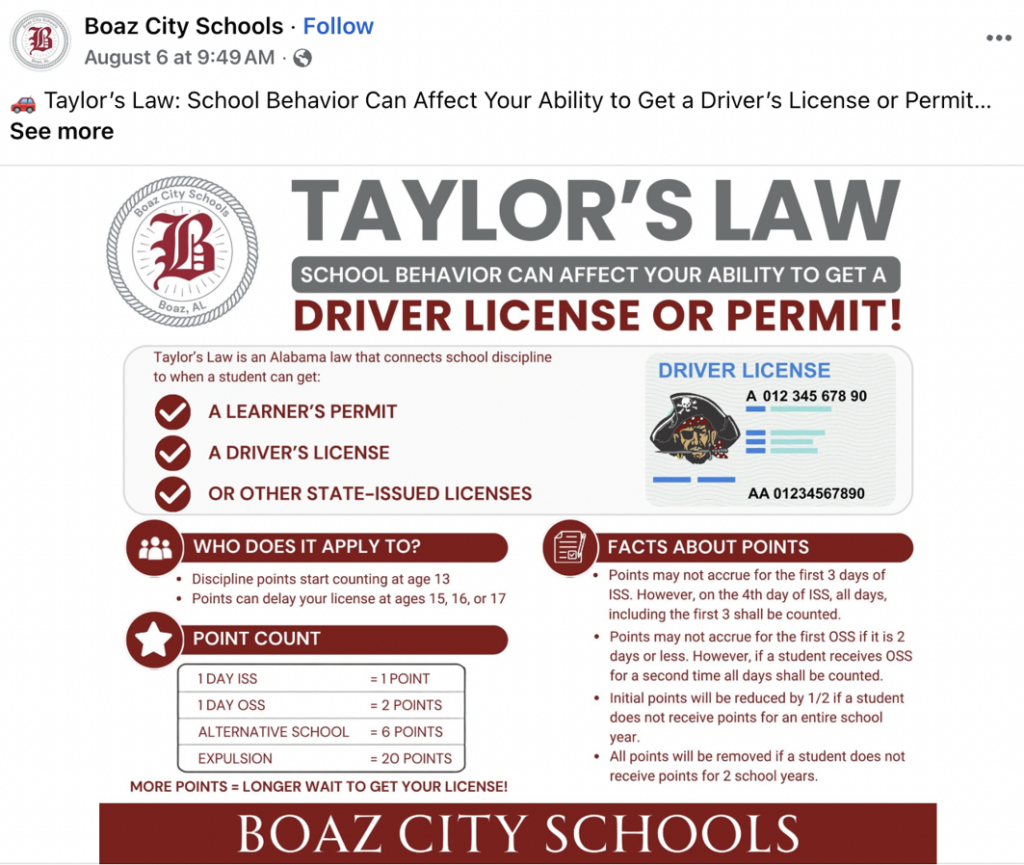
Whitney Hackett is a North Alabama mom with three kids in the public school district. She wasn’t aware of the law until her children’s school announced it on their social media page, and Hackett heard about it again at her child’s freshman orientation.
“I think it’s an interesting idea. But I feel like we should’ve heard about this a while ago. There’s a lot of confusion with parents,” Hackett told IW Features.
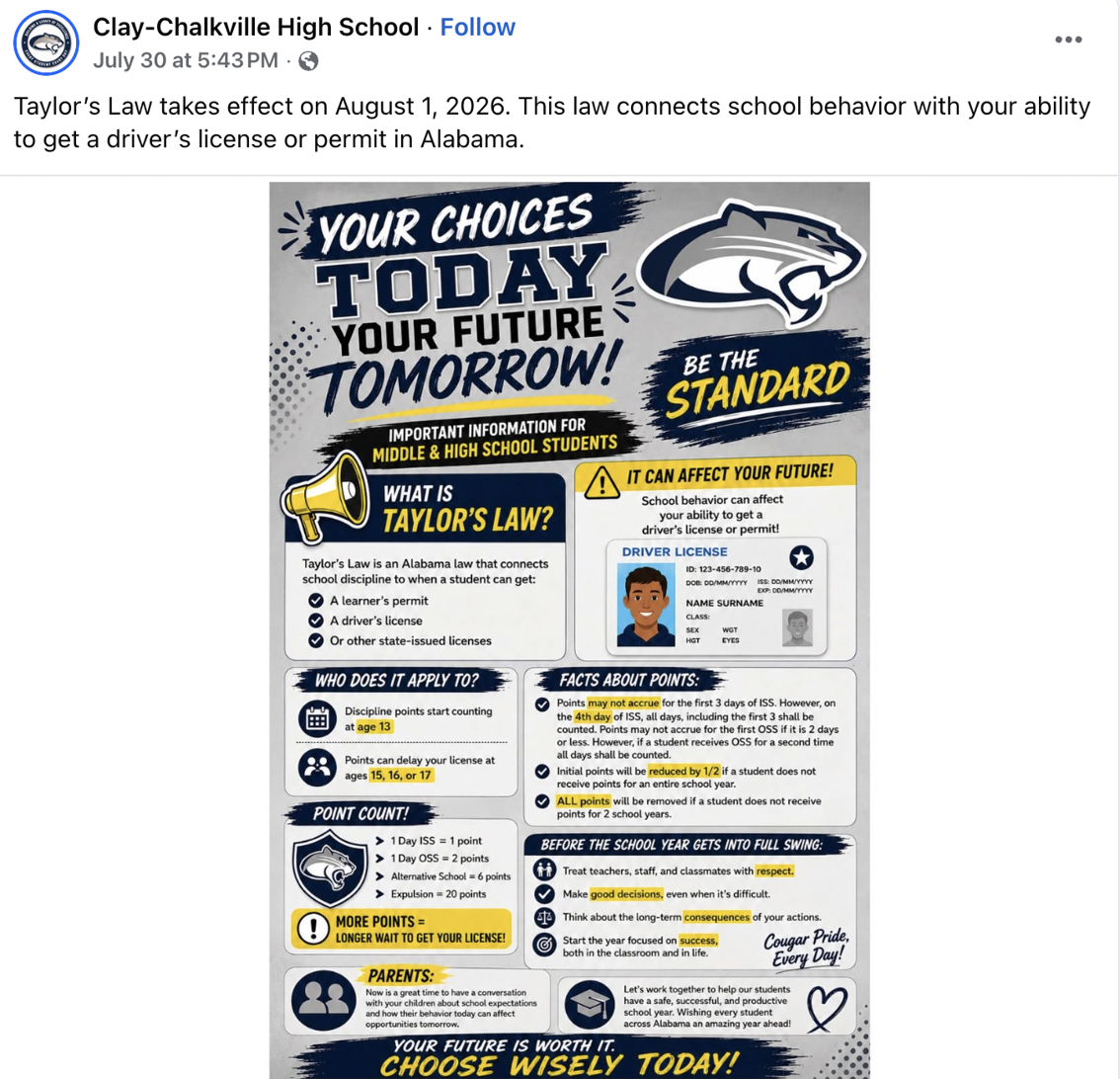
Taylor’s Law puts a new spin on incentivizing good behavior in both public and private secondary schools. Beginning when a student is 13, each disciplinary action results in one point on the student’s record. Each disciplinary action is worth a certain number of points. For example, students will receive one point for an in-school suspension and 20 points for expulsion. These points then determine a waiting period before a student becomes eligible to obtain their learner’s permit or driver’s license. Twelve disciplinary points, for instance, would result in a waiting period of 12 weeks.
A student can reduce their points by half if they complete one year without disciplinary infractions, or erase their points altogether if they complete two years without any incidents.
The number of points is managed by the student’s school, but license eligibility is determined by the Alabama Law Enforcement Agency (ALEA), who receive a student’s specific disciplinary information directly from schools. ALEA plays no part in determining the points system, which initially was a point of confusion amongst parents and students.
School administrators have spoken positively about the law, noting that a driver’s license is, ideally, enough of a privilege to use as an incentive for good behavior. One Elmore County school administrator said that the law helps demonstrate to teens that their actions have real consequences. Even if they’re not thinking about getting a license at 13 years old, they’re probably thinking about it at 16.
Montgomery Public Schools published an infographic for parents with their own encouragement: “Be respectful. Make good choices. Earn your future.” Countless other schools throughout the state have rolled out similar campaigns on social media, introducing or reminding parents of the law taking effect for this upcoming school year.
But the law isn’t without its critics.
Many skeptics have taken to social media to raise concerns over the severity of the law’s restraints, especially in the maximum punishment, which could delay a student’s license by several months. (The law has a maximum wait period of one year from the date of a student’s eligibility.)
“As someone who has worked in law enforcement and coached youth sports, I’ve seen a lot of kids make bad decisions. In my experience, many of those behaviors can be traced back to what they’re [dealing] with at home or the guidance they’re receiving from the adults around them,” said Aaron Anderson, a Morgan County resident. “Hold students accountable, absolutely. But I believe we should focus on addressing the root causes of the behavior instead of piling on another long-term consequence.”
Others have argued that the incentive really targets more economically privileged students, who expect to begin driving immediately when they get their license because they have access to a car. For lower-income students or those without cars, that same incentive might not be as effective.
And many have pointed out that the law makes no mention of mandating or teaching safe driving practices, which might curb careless driving more than school discipline.
Still, the majority of Taylor’s Law proponents agree that students will benefit once they realize that driving is a privilege, not a guaranteed right a teen has once they come of age.
Alabama is not the only state with similar structures relating student discipline to their ability to drive. A South Carolina code links school attendance with driving eligibility, and a Georgia law delays those same privileges according to a student’s school disciplinary history.
Though the law isn’t new to the legislature, it’s new to thousands of teachers, parents, and students hoping to become drivers this year. While public reaction has been mixed, only time will tell if the legislation is truly effective at curbing reckless habits and making safe drivers out of well-behaved students.